
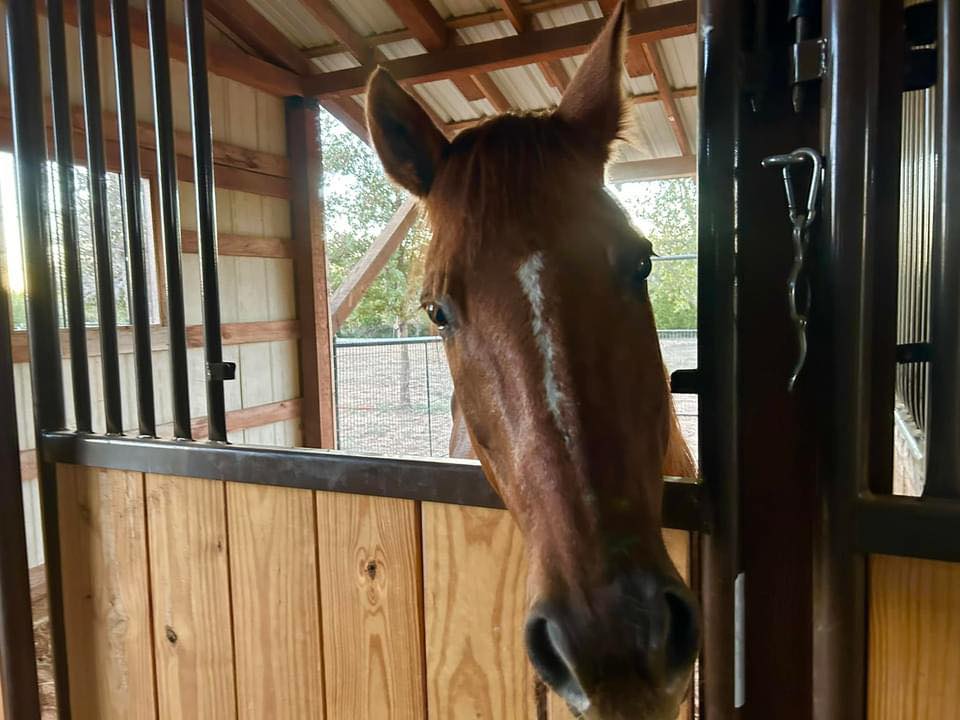


The other night we had a brush (again) with a horse who was starting to show signs of beginning stages of colic, a very scary and potentially fatal situation. Just our couple of years owning horses have showed us how important it is to really know your horse/s typical behaviors. In both cases we’ve experienced as new horse owners, we were super-fortunate to have caught it in time before worsening!
This latest episode involved my horse, Parker. Monday evening at feeding time, we noticed he was moving a little less enthusiastically to his stall for feeding and I don’t recall him “obsessively pacing” in and out of his stall as he usually does, while we prep the food buckets. He was eating very slowly, and was closing his eyes exhaustedly as I was greeting him, messing with his forelock, while eating. That was my first red flag.
Our next red flags were that he no interest in their handful of alfalfa we offer after their feed, which I use as an opp for them to hang around while I untangle a briar from a mane, or brush them out real quick and give them a protective layer of fly spray. He also wanted NOTHING to do with fly spray (which he doesn’t love anyway, but really didn’t feel up to at all on this day). And then, I noticed he was starting to paw the ground, as if alerting us that something was just not right.
So, we immediately got on the phone with the vet and our good “horse-friend” across the street (who used to be a vet tech and has numerous horses of her own). She and the vet were both on the same page, advising us what to do – give banamine (an anti-inflammatory that is particularly suited to relieve belly pain in these cases) and an electrolyte paste. Of course, we had neither of these on-hand (that weren’t long-expired), so my next door neighbor came to the rescue on that! She’s also very experienced horsewoman so she listened for gut sounds (yes, good sign) and felt his body was not overly hot, so that stuff was also checking out as normal.
Very soon after we got banamine and electrolytes into Park, he started perking up. We were still advised to stall him for the rest of the evening, until we could get several poops out of him that were normal (which would indicate there’s no blockage – a major cause of colic). Just like with kiddos over the years, poops can be encouraged with walking, or (unlike kiddos and to my surprise last time this happened with our other horse, Ranger) by simply loading up into the trailer to go for a ride! Also very important, no more hay or food for a colicking horse – just water. So we stalled his bff’s as well, for the evening, with everybody’s fans running for optimal “cooling” (even though its August in Texas, so “cool” is a relative term) to help him try to be as calm and comfy as possible. Then I haltered him up to go for a walk. We got a poop out of him pretty quick, and normal-looking (not diarrhea, which is also a red flag with colic) too. So, good sign.
After eating dinner ourselves, we went back down to check to make sure symptoms weren’t getting worse (lying down, rolling, thrashing, all of which are not good, nor was he exhibiting any of those type symptoms), walked him again – no more poops. So, stall for the night it was…with “colic checks” later throughout the night.
At the 1 a.m. check, Park was lying down resting (as usual, no rolling or seeming uncomfy) but we unfortunately saw no poops in Parker’s stall (what we were hoping for), but of course, there’s no “input” going in, so I guess its unlikely we see much “output.” However, his demeanor was still toward the normal side of the spectrum, he was showing a desire for food, checking his food bucket, nickering to us when we arrived in hopes of some food appearing in his bucket as usual, so that’s a positive sign as well. But, because there was no poops, I haltered him up to walk him around the barn’s semi-lighted area anyway, took him to the water trough to get a drink (he wasn’t drinking from his water bucket, maybe because they never usually have reason to use in their stalls).
As I was at the water trough with Park, Ronnie noticed a copperhead slithering out of Parker’s stall area and let me know. I walked Parker wide while Ronnie went and got the barn shovel and in one javelin-toss of the shovel stunned the snake enough to finish the job. **Disclaimer: we are generally wildlife lovers and respect the purpose of every living creature** – except venomous snakes and spiders (which Texas has a LOT of), especially in our barn and horse stalls! So in this case, with a venomous snake, because the head can still bite and inflict venom AFTER the snake is technically dead, protocol is to sever the head and bury it so another nighttime animal or human doesn’t come across it until it is completely non-active. So that is what we did. At 1 a.m. And we were thankful to God for that good timing. And one less copperhead around the pasture.
Parker update – we suspect perhaps the heat and unusual for August humidity this part of Texas was experiencing was just getting to him and triggering the beginnings of colic, and we interfered in time enough for him to be able to rebound successfully. In the morning, after the 12 hour dose of banamine had worn off, Parker was behaving normally – a great sign – no weakness/fatigue, no pawing, and of course, WAY interested in getting fed just like usual. So in tandem with the vet’s morning communication, we tried him with a little alfalfa and with a short walk he was able to produce a normal poop, so that combined with his normal “attitude,” we decided to turn him back out with the herd again and as of mid-afternoon – so far, so good!
Tips we’re sharing about colic:
1. Have some banamine on-hand at all times. Seeing as how you’ll be visiting the vet either today, tomorrow, or sometime in the near future if you’re a horse owner, there’s plenty of opportunities to ask for some banamine to keep in your barn!
2. Know your horse/s and their typical feeding routine behaviors. In both cases of colic that we’ve had a brush with, we’ve noticed the very first sign is less-excitement at feeding time. So that’s an immediate eyebrow raiser for us.
3. Also, there are plenty of opinions on feeding your horse. In our case, with our setup and our particular horses, we opt to bring ours in twice a day with a little feed – in addition to what they have available on any given day – 16 acres of grass and a good round bale of coastal hay – so that we can have an eyeball on them to assess for injuries or potential colic, as both of these can happen to horses year-round.
Designed with WordPress
 Everyday at the 4J
Leave a comment